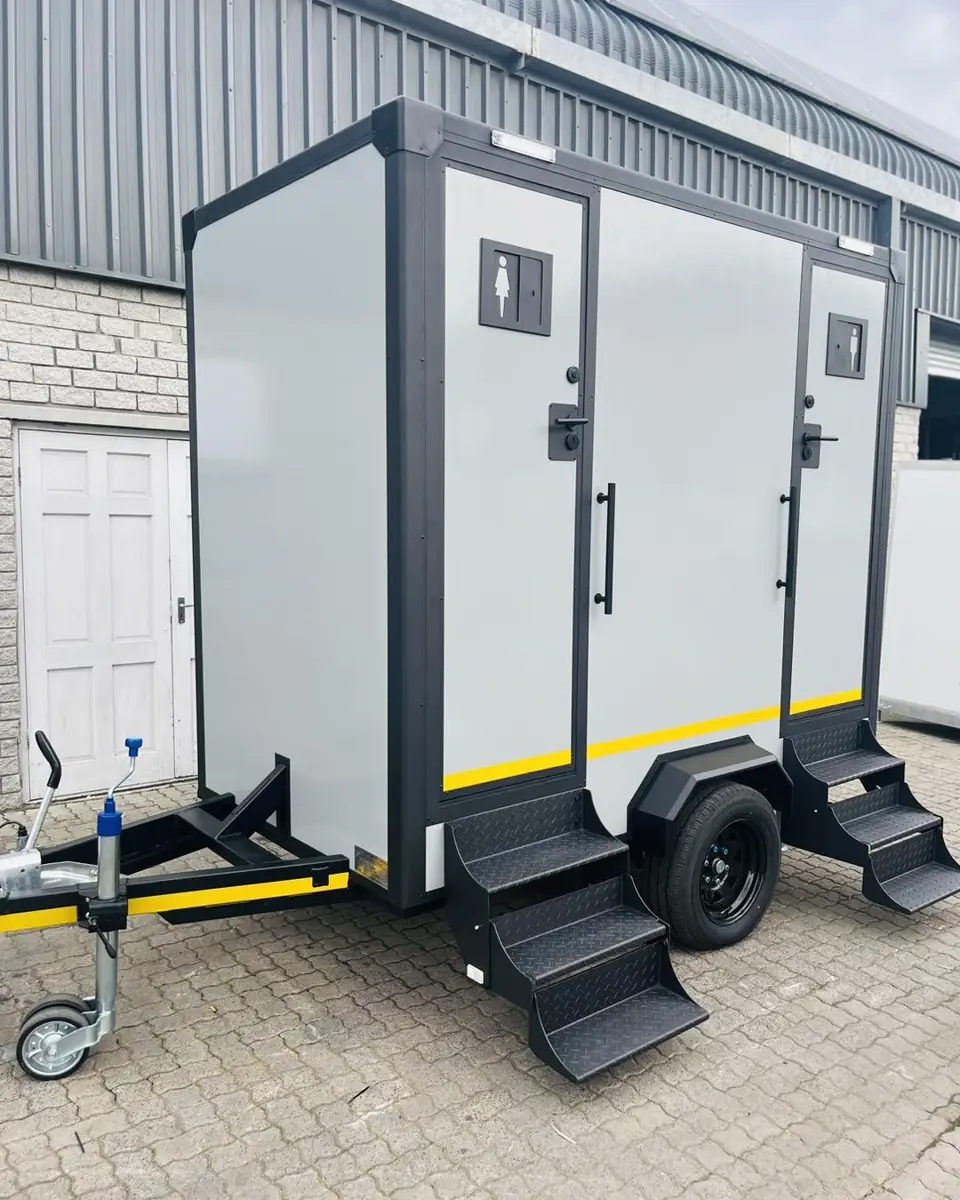
What does a restroom trailer need on site?
A restroom trailer needs a level spot about 10 by 25 feet that a pickup truck can back into, a standard 110-volt outdoor outlet within 100 feet, and a garden hose connection. With no outlet or hose nearby, we add a quiet generator and a fresh-water tank so the trailer runs on its own.
| Trailer | Stalls | Guests, 5-hour event | Power | Water |
|---|---|---|---|---|
| Two-stall trailer | 1 women's + 1 men's (with urinal) | Up to about 125 | One 110V 20-amp outlet | Garden hose or our tank |
| Three- to four-stall trailer | 2 women's + 1–2 men's | Up to about 250 | One 110V 20-amp outlet | Garden hose or our tank |
Trailers are wrong for a site with no level ground, a tight gate or a soft lawn the truck can't cross. For those, flushing units with sinks give guests a similar feel without the footprint.
What is inside a restroom trailer?
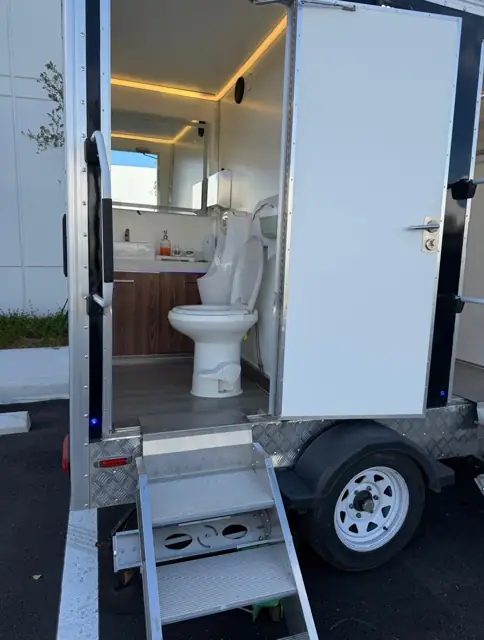
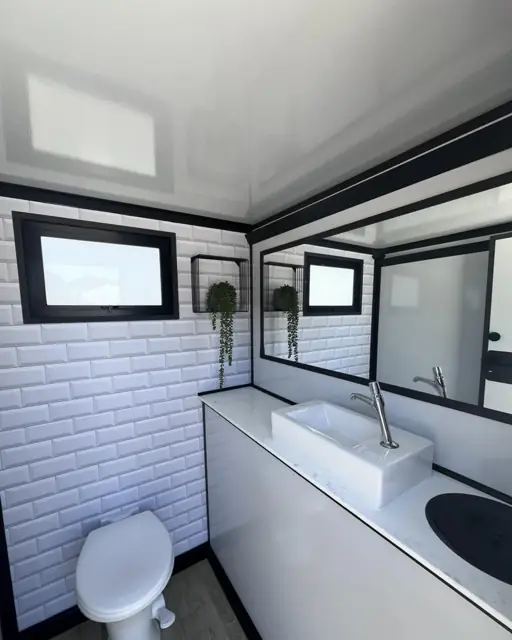
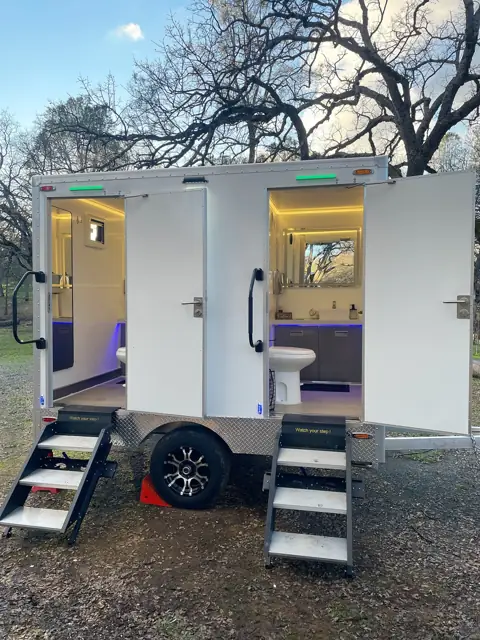
Inside a restroom trailer are porcelain flush toilets, running-water sinks with soap and paper towels, mirrors, lights, a fan, climate control and a locking door on each stall. The men's side has a urinal. Steps with a handrail lead up to each door, and the stalls are cleaned and stocked before delivery.
Restroom trailer or porta potties for a wedding?
Choose a restroom trailer for a wedding over about 75 guests, a dress-up crowd or an evening reception. Choose flushing units with sinks for a smaller wedding, a tight backyard, or a budget under about $1,000. Standard porta potties fit casual receptions only.
Mixing works well: one trailer near the reception plus one standard unit near the parking area. Guest counts by hour are in the calculator.
When is a wedding restroom trailer delivered?
A wedding restroom trailer is delivered the day before the event, leveled, connected and tested, then picked up the next business day. Same-day delivery is not offered for trailers, because hookup and testing need time before guests arrive. Book trailers 3 to 6 weeks ahead for spring and fall Saturdays.