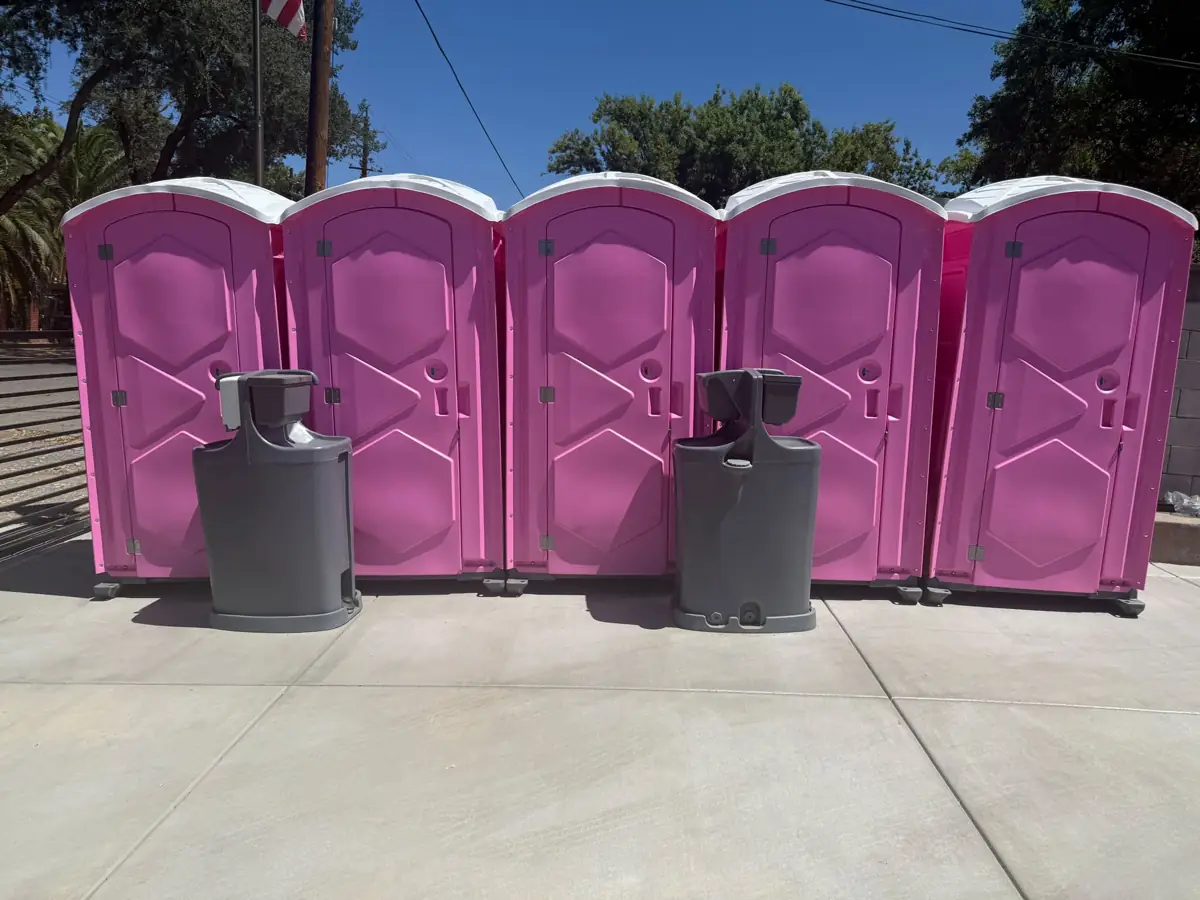
Porta potty calculator
The porta potty calculator gives a unit count in seconds. For events it starts with 1 unit per 50 guests for 4 hours, then adds whole units for longer events and alcohol. For crews it shows the Cal/OSHA legal minimum and our service-based recommendation side by side, plus hand washing and accessible units.
How many porta potties do I need for 100 guests?
100 guests need 2 standard porta potties for an event of up to 4 hours. For a 5- to 8-hour event, add 1 unit to make 3. If alcohol is served, add 1 more to make 4. Include at least 1 wheelchair-accessible unit if the event is open to the public.
How the calculator does the math
The calculator uses whole-number steps, never percentages you have to work out. Step one is 1 unit per 50 guests for 4 hours. Step two adds 1 unit per 100 guests past 4 hours. Step three adds 1 unit per 100 guests when alcohol is served. Every step rounds up.
- Base: guests ÷ 50, rounded up. 130 guests → 3 units.
- Long event: over 4 hours, add guests ÷ 100, rounded up. 130 guests → add 2.
- Alcohol: add guests ÷ 100, rounded up. 130 guests → add 2.
- Accessible: at least 5% of units per cluster, and at least 1, for public events (ADA 213.2).
- Hand washing: 1 station per 2 toilets when food is served.
Worked example: 130 guests, 6 hours, with a bar and food → 3 + 2 + 2 = 7 units, 1 of them accessible, plus 4 hand washing stations.
This event method is our planning guide from delivering and servicing events. It is not a legal standard. Crew numbers use Cal/OSHA 8 CCR 1526 (construction, 1 per 20 workers) for the legal minimum; farm crews follow 8 CCR 3457.
When should you order more units than the calculator says?
Order 1 more unit than the calculator shows when most guests arrive at once, such as a ceremony break or halftime; when the crowd is mostly women; when it is over 95°F; or when units sit far apart. Order fewer only if the building's indoor restrooms will stay open and reachable.